
Over-optimizing for returning visitors can quietly undermine Google Ads growth, even while performance metrics appear strong. Returning users convert more easily because intent already exists, which inflates conversion rates and lowers CPAs without actually expanding demand. As campaigns increasingly rely on warm traffic, Google’s algorithms receive less exposure to cold-audience behavior, reducing their ability to learn how to acquire new users at scale. The result is a deceptive sense of efficiency where spend can no longer grow without performance deteriorating, creating a hidden ceiling on acquisition.
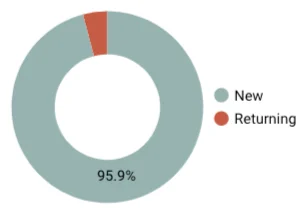
The “New Visitor Learning Tax” in Smart Bidding
Smart Bidding systems depend on exposure to new users to refine predictive models and expand reach. New visitors introduce uncertainty, convert at lower initial rates, and raise short-term CPAs, which many advertisers interpret as inefficiency. In response, budgets are often redirected toward remarketing, inadvertently starving the algorithm of the very data it needs to scale. This creates a “learning tax” where avoiding short-term discomfort leads to long-term stagnation, as bidding models lose their ability to identify and pursue new demand signals.
New vs Returning Visitors as a Signal of Market Saturation
The balance between new and returning visitors often reveals market conditions before traditional performance metrics do. A rising share of returning users may indicate healthy brand maturity, but it can also signal audience exhaustion when total user growth stalls. When acquisition slows and repeat traffic increases disproportionately, it suggests campaigns are recycling the same audience rather than expanding reach. This shift typically precedes CPA inflation, making visitor mix a leading indicator of scaling limits rather than a lagging metric.
Audience Fatigue Detection Using Returning Visitor Velocity
The speed and frequency with which users return provides deeper insight than percentages alone. Rapid repeat visits, especially when driven by paid ads, can indicate fatigue rather than intent. When users revisit frequently without progressing toward conversion, it often reflects overexposure to the same messaging. This mismatch between visit frequency and purchase behavior acts as an early warning sign of ad burnout, allowing teams to intervene before performance visibly declines.
Creative Amnesia: Why Returning Users Stop Seeing Ads
Repeated exposure to the same creatives leads returning users to develop creative amnesia, where ads are subconsciously ignored despite continued intent. This phenomenon explains why remarketing performance often degrades even when audiences remain qualified. Familiarity dulls emotional response, reducing attention and engagement over time. Effective growth strategies recognize that creative refresh cycles must be shorter for returning users than for new ones, countering the assumption that warm audiences need less innovation.
New Visitors Drive Long-Term ROAS, Returning Visitors Drive Short-Term Wins
Returning visitors tend to deliver immediate revenue and strong ROAS, which makes them attractive in performance reporting. However, new visitors are responsible for building future revenue streams, expanding lifetime value pools, and enabling sustainable scaling. When returning users dominate conversions, leadership teams often misinterpret high ROAS as healthy growth, overlooking the gradual erosion of acquisition momentum. The trade-off between short-term efficiency and long-term expansion becomes visible only when visitor mix is analyzed in context.
The False Loyalty Problem
A high proportion of returning visitors does not automatically reflect genuine loyalty. Many repeat visits are driven by discount conditioning, price comparison, or remarketing pressure rather than brand preference. Over time, aggressive remarketing can train users to delay purchases until incentives appear, weakening margins and eroding true brand equity. The real measure of loyalty lies in incremental value — whether users would have returned and converted without paid intervention.
New Visitor Drop-Offs as a Landing Page Quality Signal
New visitors offer the most honest assessment of landing page effectiveness because they arrive without prior brand context. High bounce rates or shallow engagement among first-time users often reveal mismatches between ad messaging and on-page value propositions, trust deficiencies, or pricing friction. Returning visitors, familiar with the brand, tend to compensate for these weaknesses, masking underlying UX and messaging problems. Analyzing new-visitor behavior exposes issues that optimization efforts frequently overlook.
Performance Max Bias Toward Returning Users
Performance Max campaigns often favor returning users because they convert more predictably, reinforcing short-term efficiency at the expense of expansion. This bias can cause PMax to lean heavily on brand searches and remarketing audiences while underinvesting in genuine prospecting. Growth appears stable on the surface, but new-user acquisition weakens beneath it. Identifying this imbalance requires isolating new-user trends rather than relying on blended performance metrics.
Visitor Mix as a Forecasting Tool
Changes in visitor composition often predict future performance more accurately than CTR or CPC. Declining new-visitor inflow combined with rising reliance on returners typically signals upcoming revenue stagnation. Slower decay in repeat visits suggests diminishing incremental value from existing audiences. Monitoring these patterns allows businesses to anticipate growth slowdowns one to two quarters before they materialize in revenue reports.
The Identity Reset Problem in GA4 and Privacy-First Analytics
Modern privacy constraints distort the distinction between new and returning visitors. Cookie loss, consent restrictions, and cross-device behavior frequently cause returning users to be misclassified as new. As a result, acquisition performance may appear stronger or weaker than it truly is, leading to flawed strategic decisions. Without acknowledging these identity resets, businesses risk scaling campaigns based on misleading signals rather than actual audience expansion.
Incrementality Testing as the Truth Serum
Incrementality testing exposes the true contribution of new versus returning users by separating causation from attribution. These tests often reveal that many returning users would convert without paid influence, while new users drive the majority of net-new revenue. Remarketing improves conversion efficiency, but it rarely creates demand. Understanding this distinction is essential for allocating budget toward genuine growth rather than inflated attribution.
Scaling Plateaus Caused by Over-Remarketing
Excessive remarketing does more than waste spend, it actively suppresses growth. By consuming budget and algorithmic attention, remarketing crowds out exploration and limits exposure to new audiences. Over time, this creates a plateau where spend increases fail to generate proportional revenue gains. Because efficiency metrics remain strong, this stagnation often goes unnoticed until scaling becomes impossible.
New Visitor Quality Matters More Than Volume
High-quality new visitors outperform large volumes of low-intent traffic in both short- and long-term performance. Google evaluates new-user quality through engagement depth, behavioral signals, and progression toward conversion, not just clicks. Sustainable growth comes from attracting fewer but better-qualified users who reinforce algorithmic learning and expand reachable demand.
The Visitor Mix That Signals a Breakout Brand
Breakout brands share a deliberate imbalance in their visitor mix, favoring new users even when it temporarily reduces efficiency. They accept higher acquisition costs in the short term to protect long-term scalability, continuously refresh creative, and treat returning visitors as validation rather than a growth engine. This controlled imbalance is a defining signal of brands positioned for sustained expansion rather than incremental gains.