
Search engines remain one of the most important entry points to the internet. They determine where users start their online journeys and which sites get the most visibility, impressions, and clicks. In 2026, traditional search engines are still the backbone of how people discover information, products, and services online.
The Top 10 Search Engines in 2026
Ranking search engines by global traffic and share of searches gives us this list for 2026:
1. Google

Google remains the undisputed leader in search, handling around 90 percent of global search queries in 2026. Its dominance is unmatched and it serves as the first point of discovery for users worldwide. Google processes an estimated billions of searches every day, powered by AI enhancements like Search Generative Experience (SGE) and deep integration with Android, Chrome, YouTube, Maps, and more
2. Microsoft Bing
Bing holds the second-largest share of search traffic globally, typically around 4 percent. Its integration with Microsoft services (Windows default search, Edge browser, etc.) and its AI Copilot features have helped sustain and slightly grow its usage. Bing also powers search results for Yahoo.
3. Yahoo Search
Yahoo continues to appear in the top three or four due to its portal appeal and legacy user base. While its share is modest (about 1.3 -1.4 percent), it attracts consistent traffic through its homepage and content ecosystem, especially in the U.S. and parts of Asia.
4. Yandex

Yandex is the leading search engine in Russia and nearby markets, with a global share of around 2–2.5 percent. Its strength lies in localized search results and services tailored to Russian language users, making it indispensable for regional SEO.
5. DuckDuckGo
DuckDuckGo is a privacy-focused search engine that does not track users. It typically captures under 1 percent of global searches but has steady growth in markets like the U.S., Germany, and India among users concerned with privacy.
6. Baidu
Baidu dominates search in mainland China, where global aggregators count all traffic separately. Its global share appears small (under 1 percent), but within China it commands the majority of searches. It remains essential for local SEO and business targeting Chinese users.
7. Brave Search

Brave Search is a privacy-respecting alternative that has gained traction by offering unbiased results and blocking trackers. It commonly appears in the top ten lists for 2026 traffic projections.
8. ChatGPT and AI-Driven Search

AI platforms like ChatGPT Search have emerged as notable traffic drivers, with millions of monthly visits. While not traditional search engines, their conversational answers and source-link results are increasingly used to discover information online, especially among younger and tech-savvy users.
9. Perplexity Search

Perplexity is another AI-oriented search tool that blends web search with language-model answers. It has carved a niche among users seeking quick, AI-generated results with references.
10. Ecosia

Ecosia delivers search results via Bing’s index and uses ad revenue to fund tree-planting projects. Its traffic share is small globally but loyal in parts of Europe, making it notable among cause-based engines.
5. Comparison Table: Market Share and Traffic
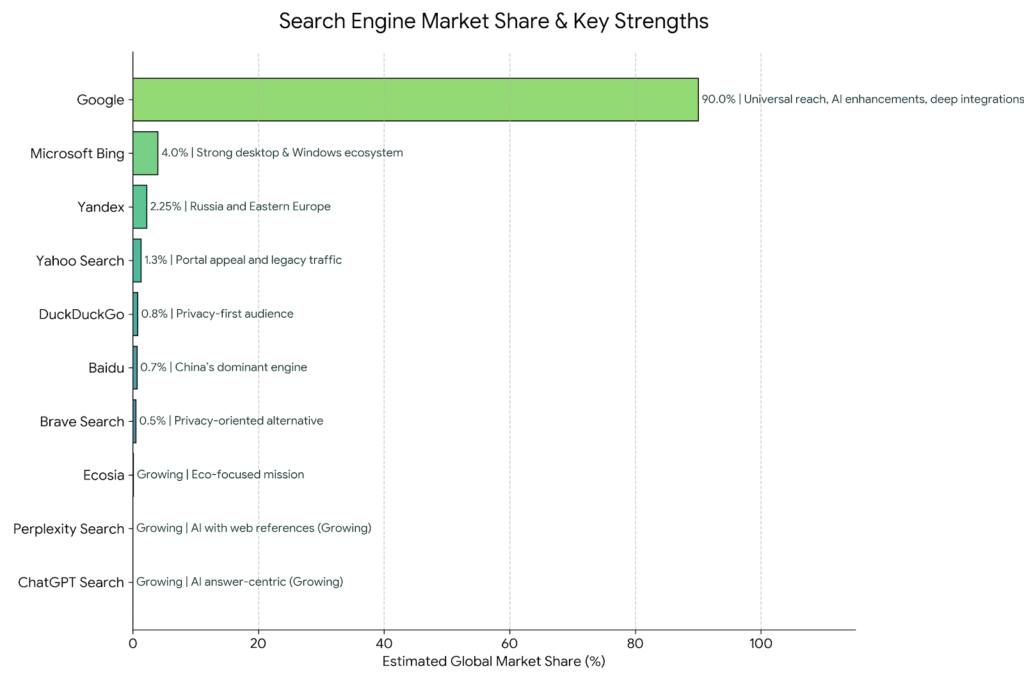
As of 2026, Google remains the dominant search engine by a wide margin, capturing around 90 percent of global search traffic. Other traditional players like Bing and Yahoo maintain smaller but stable shares. Regional engines like Yandex and Baidu remain crucial in their home markets, while privacy focused and AI-powered search tools are gaining traction and reshaping how people search online.
Understanding where your audience searches most helps you prioritize your SEO, content, and paid-search strategies for maximum impact.