
The digital landscape has shifted. In 2026, the way people in the USA and UK consume video content has moved away from passive viewing toward “active discovery.” For businesses, this means YouTube is no longer just a place to host commercials, it is a powerful engine that shapes what people want before they even know they want it. Modern audiences are savvy. They can smell a generic sales pitch from a mile away. They want authenticity, clarity, and value. This guide breaks down how to build a YouTube campaign strategy that speaks to humans, drives real interest, and ultimately moves the needle on your bottom line.
The Psychology of the 2026 Buyer
Before we look at budgets or buttons, we have to understand the buyer. Whether someone is looking for a new ceiling light in London or a software solution in New York, their journey usually starts with a feeling of dissatisfaction.
They aren’t looking for a “product.” They are looking for a change. A homeowner isn’t searching for a “5000-lumen LED fixture” they are tired of their kitchen feeling dark and depressing. YouTube’s unique power is its ability to enter the conversation at this emotional stage. By showing a transformation visually, you bypass the logical “price-checking” brain and go straight to the “I want that” brain.
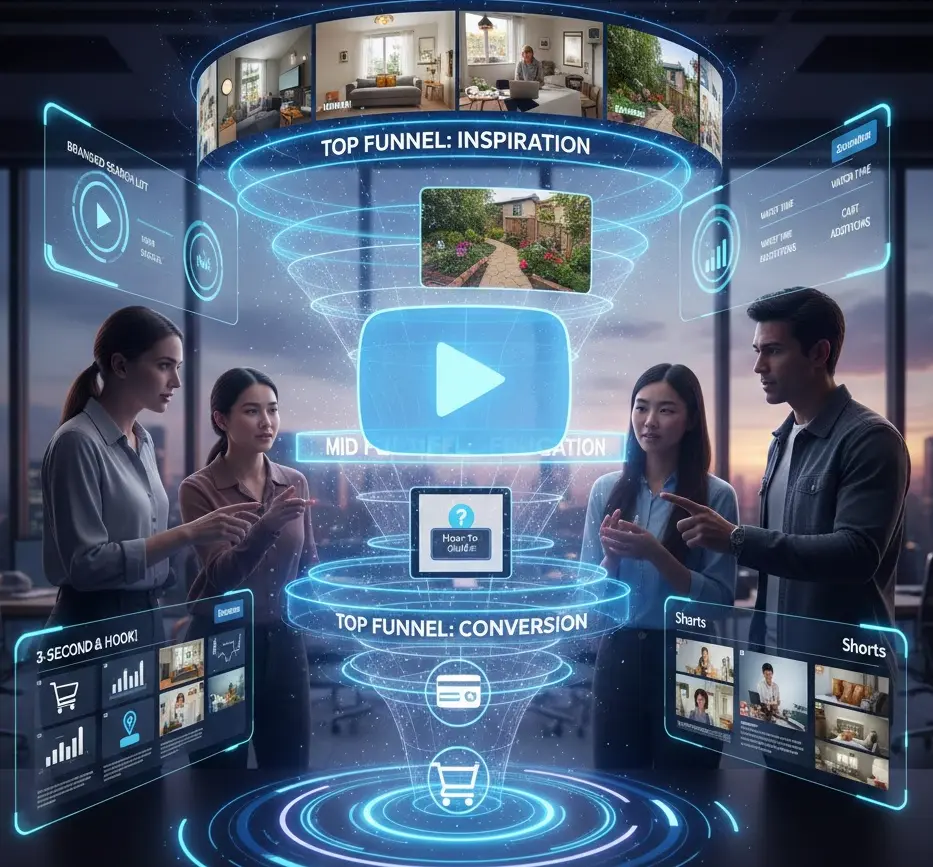
Phase 1: Top-of-Funnel (Awareness)
Building Inspiration Without the Pressure
At the top of your funnel, your goal is simple Stop the scroll. However, you shouldn’t do this with loud noises or flashing lights. In the UK and USA markets, “loud” often feels “cheap.”
Focusing on Lifestyle Over SKU
Successful campaigns in 2026 focus on possibility. If you are in the home niche, show a room being transformed by the product. If you are in the B2B space, show a person’s face relaxing as a complex task becomes easy.
The Power of “Reachable” Content
A common mistake is making your ads too aspirational. If a UK homeowner sees a lighting fixture in a 20-room mansion, they won’t buy it for their semi-detached house in Birmingham. They need to see your product in a space that looks like theirs. Use realistic room sizes, natural lighting, and relatable actors.
KPIs to Watch at This Stage
- Unique Reach: How many new people are seeing your brand?
- Earned Views: Are people clicking on your other videos after seeing the ad?
- Brand Lift: Is there an uptick in people typing your brand name into Google?
Phase 2: Mid-Funnel (Consideration)
Becoming the Helpful Expert
Once a viewer has seen your brand, they move into the consideration phase. They know they have a problem, and they know you have a solution. Now, they are looking for reasons to trust you over a competitor.
Solving Specific Problems with Content
This is where your strategy gets more granular. You should create video content that targets specific “sub-needs.”
- For Home Goods: “How to choose the right warmth for your living room.”
- For Tech: “A 2-minute walkthrough of our most popular feature.”
- For Services: “What to expect in your first 30 days with us.”
Using Demand Gen Formats
In 2026, Google’s “Demand Gen” campaigns are essential. They allow your videos to appear across Shorts, Discover, and the YouTube home feed. At the mid-funnel, these ads should feel like a recommendation from a friend rather than a hard sell.
KPIs to Watch at This Stage
- View-Through Rate (VTR): Are people actually watching the whole video or skipping after 5 seconds?
- Watch Time: If they stay for 30 seconds or more, you have captured their interest.
- Engagement: Are they liking, saving, or commenting?
Phase 3: Lower-Funnel (Conversion)
Closing the Gap and Removing Friction
The lower funnel is where the “money” happens, but it only works if you have done the groundwork. By the time a user sees a lower-funnel ad, they should already be familiar with your brand.
Remarketing with Precision
Don’t just show them the same ad again. Show them the result. If they looked at a specific category on your website, show them a 15-second “Short” featuring that specific range. Use this stage to answer the final “What ifs.”
- “Will it fit my space?” (Show a scale comparison)
- “Is it high quality?” (Show a close-up of the materials)
- “When will it arrive?” (Mention your 48-hour shipping)
The Role of YouTube in the Ecosystem
YouTube doesn’t usually live in a vacuum. It supports your Search and Shopping ads. A user might see your video on Tuesday, forget about it on Wednesday, and then search for your brand on Friday when they are ready to buy. This “cumulative impact” is the secret to 2026 marketing.
KPIs to Watch at This Stage
- Click-Through Rate (CTR): Are they actually going to the site?
- Cost Per Acquisition (CPA): Is the spend resulting in a profitable sale?
- View-Through Conversions: Did they see the ad, not click, but buy later?
Creative Strategy: How to Win the UK and USA Markets
The creative is the most important part of your campaign. You can have the best targeting in the world, but if the video is boring, it will fail.
Authenticity Wins Every Time
We have moved past the era of “Studio Perfection.” Today, audiences respond to “Lo-Fi” content that feels human. Using a smartphone to film a real-life installation often performs better than a £10,000 production. It feels more honest.
The 3-Second Hook
You have three seconds to prove you aren’t wasting the viewer’s time.
- Don’t: Start with your logo and a long intro.
- Do: Start with a question or a visual “Before” shot.
- Example: “Still living with those yellow, dim ceiling lights?” instantly identifies the problem and the audience.
Short-Form vs. Long-Form
In 2026, you need both.
- Shorts (Vertical): Perfect for quick tips, “unboxings,” and remarketing.
- Long-Form (Horizontal): Best for deep dives, tutorials, and building authority.
Common Pitfalls: Why Campaigns Underperform
If your YouTube ads aren’t working, it is rarely a problem with the platform. Usually, it is a disconnect in the journey.
1. The “Boring” Factor
If your ad looks like a TV commercial from 2010, people will skip it. You have to match the “energy” of the platform. YouTube is about entertainment and education. If your ad does neither, it’s just noise.
2. The Landing Page Disconnect
If your video shows a beautiful, warm living room, but the link takes the user to a generic homepage with 500 items, they will leave. You must send them to a page that mirrors the “vibe” and the “product” shown in the video.
3. Ignoring the “Silent” Viewer
Many people watch YouTube on their phones with the sound off (especially in public or during commutes). If your video doesn’t have clear captions or visual cues, your message is lost.
Summary of Strategy by Niche
| Niche | Primary Strategy | Key KPI |
| Home/Interior | Transformation & “The Look” | Branded Search Lift |
| SaaS/Tech | Problem/Solution Walkthrough | Free Trial Sign-ups |
| Professional Services | Face-to-Camera Trust Building | Lead Form Fills |
| E-commerce/Retail | Unboxing & Social Proof | Return on Ad Spend (ROAS) |
The brands that win on YouTube this year are the ones that stop trying to “hack the algorithm” and start trying to help the customer. By creating a funnel that moves from Inspiration to Education and finally to Action, you build a brand that people actually like.
YouTube is no longer a “side” channel. It is the bridge between a customer having a problem and you providing the solution. Treat your video content as a long-term asset, and it will continue to pay dividends long after the initial campaign ends.