
Why PPC Competitor Analysis Is No Longer Optional
After managing Google Ads accounts for over 15 years, one truth has become clearer than ever: You don’t win PPC by guessing and you win by understanding your competitors better than they understand themselves.
PPC competitor analysis is the process of researching, evaluating, and reverse engineering your competitors’ paid advertising strategies to improve your own performance. In today’s highly competitive auction-based environment, ignoring competitor intelligence leads to wasted spend, poor Quality Scores, and missed opportunities.
This guide breaks down exactly how professionals analyze PPC competitors, which metrics actually matter, and how to turn insights into profitable actions.
What Is PPC Competitor Analysis?
PPC competitor analysis is the systematic evaluation of other advertisers bidding on the same keywords, audiences, or placements as you in platforms like:
- Google Ads
- Microsoft Ads (Bing)
- YouTube Ads
- Display & Discovery campaigns
The goal is not to copy competitors blindly, but to:
- Identify market benchmarks
- Spot strategic gaps
- Improve ad relevance and conversion efficiency
- Protect your auction share
Why PPC Competitor Analysis Is Critical for Google Ads Success
1. Rising CPCs Demand Smarter Decisions
With CPCs increasing year over year, efficiency matters more than volume. Competitor analysis reveals where competitors overspend or underperform, giving you a cost advantage.
2. Auction Insights Change Weekly
Your competitors’ bids, budgets, and ad strength change constantly. Ongoing analysis keeps you ahead of shifts in impression share and outranking metrics.
3. Stronger Ads Win More Than Higher Bids
Understanding competitors’ messaging, offers, and extensions helps you outperform them without increasing bids.
7 Ideal Steps For In-depth Competitor Analysis
Step 1: Identify Your True PPC Competitors
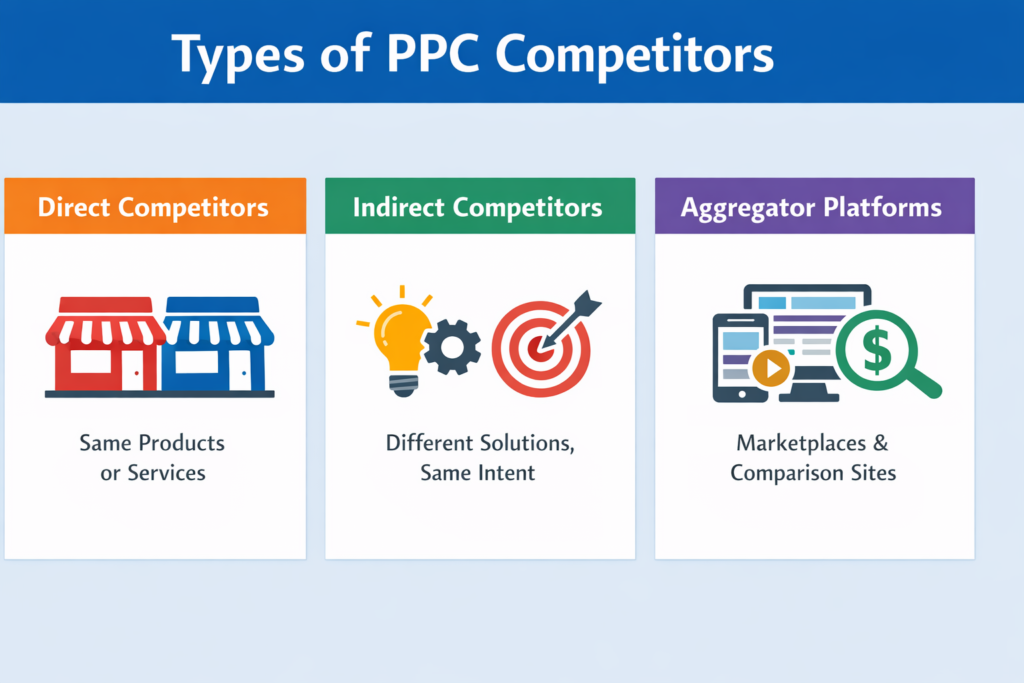
Types of PPC Competitors
- Direct competitors – Sell the same product/service
- Indirect competitors – Different solution, same search intent
- Aggregator platforms – Marketplaces, directories, comparison sites
How to Find Them
- Search your core keywords in Google
- Review Auction Insights Report
- Use keyword overlap tools
- Analyze impression share trends
Step 2: Use Google Ads Auction Insights (Most Underused Tool)
The Auction Insights Report provides real, first-party data.
Metrics That Matter
- Impression Share
- Overlap Rate
- Outranking Share
- Top of Page Rate
- Absolute Top of Page Rate
What Experts Look For
- Who consistently outranks you?
- Who appears but rarely beats you?
- Who dominates top positions during peak hours?
This data helps you decide when to increase bids, improve Quality Score, or change strategy entirely.
Step 3: Analyze Competitor Keyword Strategy
Questions to Answer
- Are competitors bidding on branded keywords?
- Do they focus on high intent commercial terms?
- Are they aggressively targeting long-tail queries?
Expert Insight
Many advertisers waste budget on broad keywords. Smart competitor analysis often reveals high ROI long-tail opportunities they overlook.
Step 4: PPC Ad Copy Competitor Analysis (Where Money Is Made)
What to Review
- Headlines used repeatedly
- Emotional triggers (price, trust, urgency)
- Offers (free trials, guarantees, discounts)
- CTA language
Common Patterns You’ll Notice
- Overused generic claims (“Best Service”, “Affordable”)
- Weak differentiation
- No proof or credibility signals
How to Beat Them
- Address objections directly
- Use specific numbers, outcomes, or timelines
- Match ad copy tightly to search intent
Step 5: Review Competitor Landing Pages
Your ad does not convert the landing page does.
Analyze:
- Page speed and mobile experience
- Message match between ad and page
- Trust signals (reviews, certifications)
- Conversion friction
Expert Observation
Many competitors run great ads to terrible landing pages. This is often the easiest win in PPC.
Step 6: Monitor Competitor Bidding & Budget Behavior
Signs of Aggressive Bidding
- Sudden increase in overlap rate
- Consistent absolute top impression share
- Higher CPC volatility
Strategic Response
- Shift to time based bidding
- Focus on high margin segments
- Reduce waste instead of chasing position
Step 7: Audience & Funnel Strategy Analysis
Modern PPC goes beyond keywords.
Check If Competitors Are Using:
- Remarketing audiences
- In-market segments
- Custom intent audiences
- YouTube & Discovery placements
Opportunity Gap
Many advertisers rely only on search. Multi-touch funnel coverage is often weak, especially mid-funnel.
Common PPC Competitor Analysis Mistakes
- Copying ads without context
- Obsessing over CPC instead of CPA
- Ignoring landing page quality
- Treating competitor data as static
- Overreacting to short-term changes
Turning Competitor Insights into Action
Real PPC growth happens when you:
- Improve Quality Score instead of bidding wars
- Exploit gaps in competitor messaging
- Focus budget on intent-rich queries
- Build stronger post-click experiences
Competitor analysis informs strategy it does not replace it.
Final Thoughts from a 15 Years Google Ads Practitioner
PPC competitor analysis is not about spying it’s about market intelligence.
In my experience, the advertisers who win long-term are not the ones with the biggest budgets, but the ones who:
- Monitor competitors consistently
- Adapt faster than the auction
- Focus on user intent, not ego
If you treat PPC competitor analysis as an ongoing discipline rather than a one-time task, Google Ads becomes predictable, scalable, and profitable.