
Understanding Google Ads Benchmarks for Real Estate in 2026
When you talk about Google Ads performance in 2026, especially for the real estate sector, you have to look beyond simple clicks. Real estate traffic is uniquely competitive because intent varies wildly. Some users are in research mode, casually browsing aesthetics, while others are in purchase mode, ready to sign a contract. The true performance story is found in how effectively you turn that intent into leads with actual sales value.
In 2026, benchmarks have shifted significantly. Costs per click are generally higher and conversion rates have tightened. This is largely because advertisers have become more sophisticated with targeting and Google’s AI now automates a massive portion of the auction process. Success today requires aligning your search intent, creative messaging, and landing page experience so that every dollar spent moves you closer to revenue, not just a higher hit count.
Analyzing Click-Through Rate (CTR)
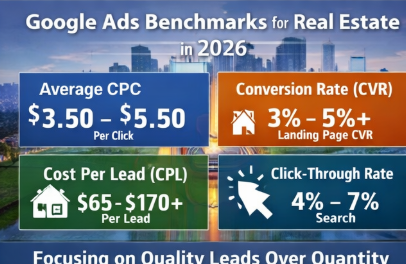
CTR is the primary indicator of whether people actually notice and care about your ads. For real estate search campaigns in 2026, a healthy click-through rate typically falls between 4% and 7%. If your search CTR is consistently below 4%, it is a clear signal that your messaging, keyword alignment, or targeting needs a complete overhaul.
Display campaigns, which are primarily used for brand awareness and remarketing, see much lower engagement. In the real estate world, display CTRs usually range from 0.8% to 1.2%. This is expected since these users aren’t actively hunting for a home at that exact second. To push your search CTR toward the higher end of the 7% range, you must use precise keyword match types, relevant ad copy, and smart ad extensions.
Average Cost Per Click (CPC) Trends
CPC reflects the price of entry in a fierce market. In 2026, typical CPCs for real estate search traffic range between $3.50 and $5.50. However, in high-value urban markets or for competitive terms like “luxury apartments,” these prices can climb significantly higher. If you find yourself paying much less than $3.50 in a mature market, you are likely either targeting broad, low-intent queries or competing in a region with very low demand.
To manage these costs effectively, you must be aggressive with negative keywords and divide your ad groups by intent. This prevents high-value commercial searches from being diluted by informational queries. While the average CPC in real estate is often higher than other industries, it is a necessary investment to capture users who are ready to make the largest purchase of their lives.
Conversion Rate (CVR) and Landing Page Realities
Conversion rate is often misunderstood in real estate. A “conversion” can be anything from a phone call to a virtual tour request. In 2026, a healthy real estate landing page typically converts between 3% and 5%. If you are falling below the 3% mark, the issue usually lies with your landing page. Common culprits include using a broad homepage instead of a property-specific page, or having a form that is too long for a mobile user to complete.
Improving your conversion rate is the most direct way to lower your cost per lead. Successful landing pages in 2026 focus on “property-centric” messaging. If an ad promises a 2-bedroom apartment, the landing page must immediately show that specific floor plan. High-quality visuals, fast loading speeds, and clear calls-to-action like “Get Price List”are no longer optional; they are the baseline for conversion.
Cost Per Lead (CPL) and Lead Quality
Cost Per Lead is the ultimate benchmark for real estate PPC. In 2026, search campaign CPLs typically range from $65 to $170. This wide range depends on the market tier and the product type. For example, a lead for a first-time homebuyer might cost $70, while a lead for a commercial investor in a coastal city could easily exceed $150.
It is vital to remember that lead quality trumps lead cost. A $140 lead that is highly qualified and ready to buy is infinitely more valuable than a $60 lead that never answers the phone. Efficient campaigns in mid-tier cities aim for the $65 to $90 range, provided the sales follow-through is solid. In 2026, you aren’t just buying data; you are buying a seat at the table with a potential client.
A Case Study in Optimization: HutnHomes
A real-world example of these benchmarks in action is HutnHomes, a property agency that sought to increase lead volume while reducing costs. By shifting to a campaign structure focused on high-commercial intent phrases and refining their landing pages for mobile users, they saw a dramatic shift over 90 days. Their leads increased from 40 to over 64 per month, and their CPL dropped from $150 to $70.
This success was driven by segmenting the audience by intent separating buyers from investors and using smart bidding models. By leveraging Google’s AI to allocate spend toward users most likely to convert, they improved their landing page conversion rate from 2.5% to 4%. This proves that even in a high-cost environment, a data-driven approach can significantly outperform industry averages.
Geographic Variations and Final Performance Snapshot
Traffic dynamics vary by region. In the United States and Canada, competition drives CPLs toward the $90–$170 range. In Europe, CPCs are slightly lower, ranging from $3.50 to $5.50, though major hubs like London remain expensive. Emerging markets in Asia and the Middle East often see lower CPCs near $2.50, though conversion behavior differs significantly.
In summary, strong real estate PPC performance in 2026 looks like a search CTR of 4% to 7%, an average CPC of $3.50 to $5.50, and a conversion rate above 3%. These numbers should be your guide, but your own account data is your ultimate North Star. Success is about the alignment of the entire funnel from the first search to the final closing.