
Table of Contents
- Introduction: The Economic Imperative of Efficiency
- Chapter 1: Foundations of Modern CRO
- Defining Conversion Rate Optimization in 2026
- The “Why”: The Economics of Optimization vs. Acquisition
- Conversion Rate Optimization Fundamentals: Drivers, Barriers, and Hooks
- Chapter 2: The Scientific Methodology: Steps of Conversion Optimization
- Moving Beyond Guesswork: The Iterative Cycle
- The Importance of Statistical Significance
- Chapter 3: Deep Diagnosis: CRO Analysis Techniques
- Quantitative Analysis: Finding the “Where”
- Qualitative Research: Understanding the “Why”
- Chapter 4: The Metrics That Matter
- Macro vs. Micro Conversions
- Essential CRO Metrics and Statistics to Monitor
- Chapter 5: Executing Strategies and On-Page Techniques
- High-Impact Conversion Optimization Strategies
- CRO On-Page Essentials: Copy, UX, and Psychology
- Developing Actionable CRO Recommendations
- Chapter 6: Vertical Focus: E-commerce Conversion Optimization
- Optimizing the Critical Path to Purchase
- Combatting Cart Abandonment
- Chapter 7: The Optimization Engine: Conversion Rate Optimization Tools
- The Essential Technology Stack
- Conclusion: Building a Culture of Experimentation
Introduction: The Economic Imperative of Efficiency
By 2026, the digital landscape has shifted decisively. The “growth at all costs” era, fueled by cheap advertising inventory and loose privacy regulations, is over. Customer Acquisition Costs (CAC) have hit historic highs due to saturated channels and a cookie-less world that makes targeting more difficult.
In this environment, pouring water into a leaky bucket is no longer a viable business strategy. The most successful companies have pivoted their focus inward, prioritizing the efficiency of their existing traffic over the relentless pursuit of new visitors.
This is where Conversion Rate Optimization (CRO) becomes the most critical lever for sustainable growth. It is the discipline of maximizing the return on every dollar spent on traffic by ensuring that once a visitor arrives, the experience is perfectly tuned to persuade them to take action.
This guide goes beyond simple “hack” tactics. It outlines a rigorous, data-driven methodology for understanding human behavior online and architecting experiences that convert.
Chapter 1: Foundations of Modern CRO
Defining Conversion Rate Optimization in 2026
What is conversion rate optimization?
Historically, it was defined as simply increasing the percentage of visitors who complete a goal.
In 2026, we define CRO more broadly: CRO is a systematic, data-driven process of learning about your customers’ behavior to continuously improve the user experience (UX) and align it with their intent, ultimately driving more valuable actions.
It is not merely about tweaking button colors. It is an intersection of three disciplines:
- Data Analytics (The What): Identifying where friction occurs.
- User Psychology (The Why): Understanding motivation and hesitation.
- UX/UI Design (The How): Implementing solutions that resolve friction.
The “Why”: The Economics of Optimization vs. Acquisition
The math behind CRO is compelling. If you spend $10,000 a month on ads to drive 10,000 visitors, and your site converts at 1%, you get 100 customers. Your CPA (Cost Per Acquisition) is $100.
To get 200 customers, you have two choices:
- The Acquisition Route: Double your ad spend to $20,000 (assuming costs don’t rise as you scale, which they usually do).
- The CRO Route: Increase your conversion rate from 1% to 2% through optimization.
The latter approach yields the same growth without increasing ad spend, dramatically improving profitability. Furthermore, a higher conversion rate allows you to bid more aggressively for traffic, unlocking new acquisition channels your competitors cannot afford.
Conversion Rate Optimization Fundamentals
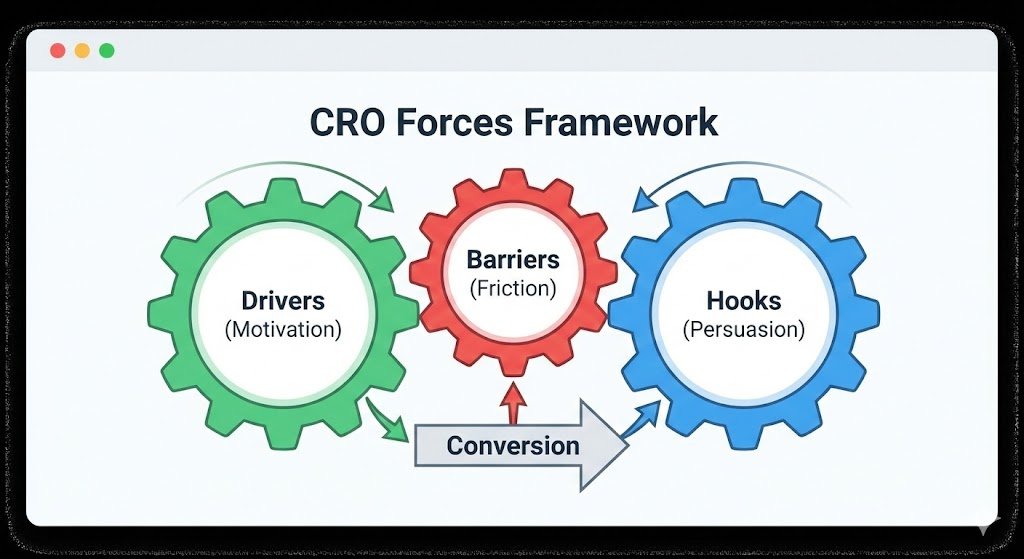
Before diving into complex testing, you must understand the fundamental forces at play on any webpage. We can view these through a simple framework:
- Drivers (Motivation): Why did the user come here? What pain are they trying to solve? Your site must immediately resonate with this existing motivation.
- Barriers (Friction): What is stopping them? This includes confusing navigation, slow load times, lack of trust, complex forms, or unclear pricing. CRO is largely the business of barrier removal.
- Hooks (Persuasion): Why should they act now? This involves persuasive elements like strong value propositions, social proof, urgency, and scarcity.
If Barriers outweigh Motivation and Hooks, conversion does not happen. The image below visualizes this interplay of forces.
Chapter 2: The Scientific Methodology: Steps of Conversion Optimization
Amateur CRO relies on “gut feelings,” best practice lists, or copying competitors. Professional CRO relies on the scientific method. What are the steps of conversion optimization? It is a continuous, iterative loop, not a linear path with a finish line.
The Iterative Cycle
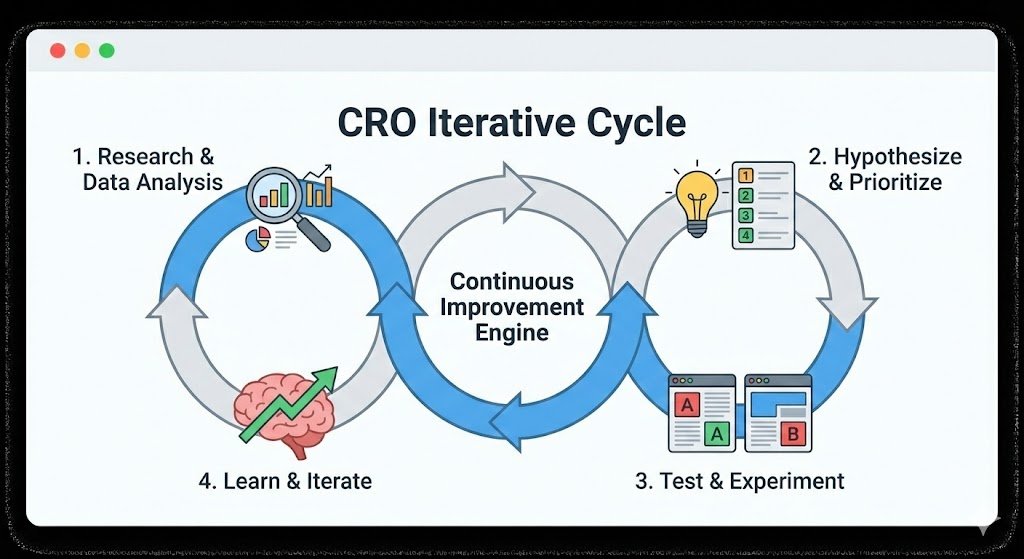
A robust conversion program follows a structured, repeatable process to ensure that every test win or lose provides learning value.
- Research & Data Analysis: This is the diagnostic phase. You gather data from multiple sources (analytics, heatmaps, surveys) to identify problems.
- Hypothesize & Prioritize: Based on the data, you formulate a hypothesis. A good hypothesis follows the structure: “We believe that [doing X] for [these users] will result in [Y outcome] because of [Z reason].”. You then prioritize these based on potential impact and ease of implementation.
- Test & Experiment: You design the variations (A/B test, multivariate test) and run them against a control group with statistical rigor.
- Learn & Iterate: You analyze the results. Did the hypothesis win? Why or why not? The learnings from this step feed directly back into the research phase for the next cycle.
The following diagram illustrates this continuous improvement engine.
Chapter 3: Deep Diagnosis: CRO Analysis Techniques
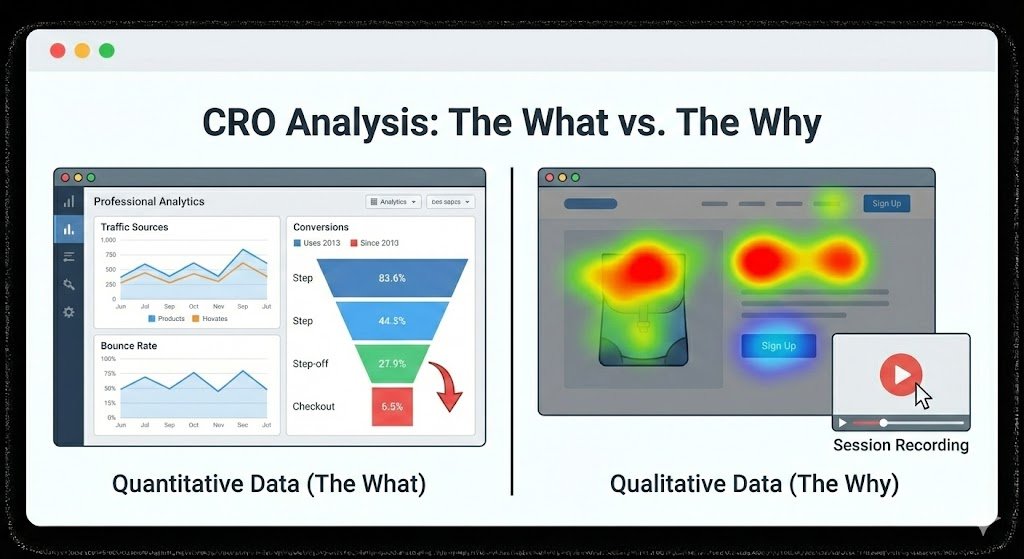
You cannot fix what you do not understand. CRO analysis is the diagnostic phase that informs all subsequent strategies. A complete analysis must balance the “what” (quantitative) with the “why” (qualitative).
Quantitative Analysis: Finding the “Where”
This relies on web analytics tools like Google Analytics 4. It tells you where leaks are happening in your funnel. Key questions include:
- Where are bounce rates high?
- At what specific step in the checkout do most users drop off?
- Which device types (mobile vs. desktop) convert poorly?
- Which traffic sources have high volume but low engagement?
Qualitative Research: Understanding the “Why”
Data tells you that people are leaving; qualitative research tells you why. This involves:
- Heatmaps & Scrollmaps: Seeing where users click, how far they scroll, and what they ignore.
- Session Recordings: Watching anonymized video footage of actual user journeys to spot friction points, rage clicks, and confusion.
- Voice of Customer (VoC): Using on-site polls, surveys, and user interviews to hear objections directly from the source.
The image below demonstrates how these two data types complement each other.
Chapter 4: The Metrics That Matter
While the headline “Conversion Rate” is important, a sophisticated CRO metrics strategy looks deeper to understand the full picture of user behavior.
Macro vs. Micro Conversions
- Macro Conversions: The primary goal of your site (e.g., completed purchase, lead form submission, software demo request).
- Micro Conversions: Small steps that indicate progress towards the main goal (e.g., adding a product to cart, signing up for a newsletter, downloading a spec sheet, viewing a pricing page).
Optimizing for micro conversions can often be a more effective leading indicator of future macro conversion success, especially for low-traffic sites.
Essential CRO Metrics and Statistics to Monitor
- Bounce Rate vs. Engagement Rate: Understanding if users leave immediately or interact without converting.
- Average Order Value (AOV): CRO isn’t just about more orders; it’s about better orders.
- Exit Rate on Key Pages: Identifying the last page a user sees before leaving can pinpoint friction.
- Form Abandonment Rate: Identifying exactly which field causes users to give up is crucial for form optimization.
Chapter 5: Executing Strategies and On-Page Techniques
Once analysis reveals the problems, it’s time to apply conversion optimization techniques. This is where strategy meets execution.
High-Impact Conversion Optimization Strategies
Successful conversion rate optimization strategies often revolve around improving the clarity and relevance of your Value Proposition. If a user arrives and cannot instantly answer “What is this?” and “What’s in it for me?”, they will bounce.
- Match Ad Scent: Ensure the landing page headline perfectly matches the ad copy that drove the click. Disconnects here shatter trust.
- Reduce Cognitive Load: Remove any element on the page that doesn’t support the primary goal. Don’t make the user think; make the path forward obvious.
CRO On-Page Essentials: Copy, UX, and Psychology
CRO onpage adjustments are the tactical execution. Key areas include:
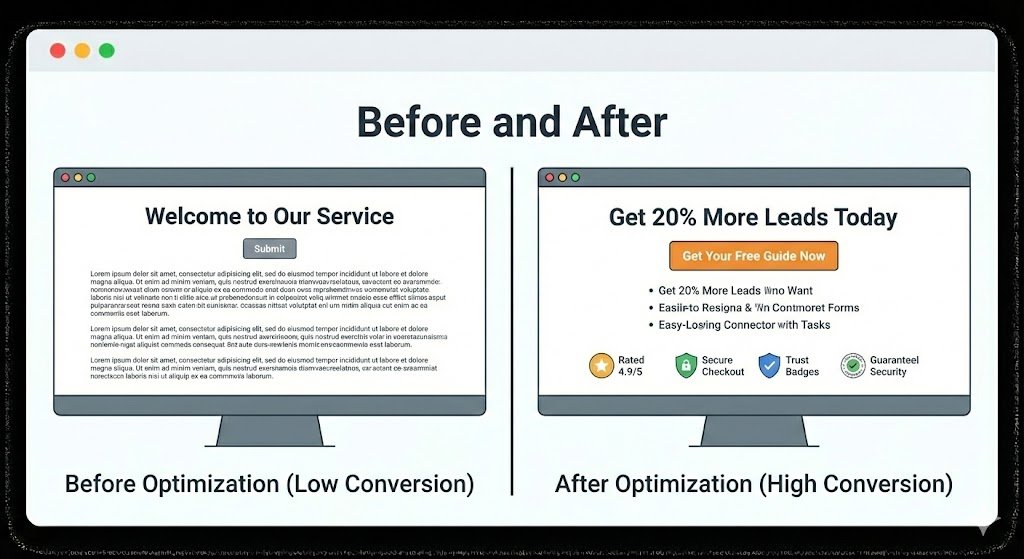
- The Headline: It must hook the reader immediately by addressing their primary pain point or desire, not by talking about your company.
- Call-to-Action (CTA): CTAs should be specific, prominent, and action-oriented. Instead of “Submit,” use “Get My Free Guide Now.”
- Trust Signals: In an era of skepticism, you must prove credibility. Use testimonials, trust badges (security seals), case studies, and clear privacy policies placed near friction points (like credit card fields).
The image below shows a clear “Before and After” example of applying these principles to a landing page.
Chapter 6: Vertical Focus: E-commerce Conversion Optimization
Ecommerce conversion optimization requires a specialized approach due to the transactional nature of the visit. The stakes are higher because money is changing hands. While general conversion rate optimization statistics often cite average rates around 2-3%, top-performing e-commerce sites often achieve double that.
Optimizing the Critical Path to Purchase
- Product Detail Pages (PDPs): High-quality images, video demonstrations, clear sizing guides, and prominent customer reviews are non-negotiable. The “Add to Cart” button must be the most visually dominant element.
- The Cart Page: This is a decision point, not just a holding area. Clearly show total costs. Avoid surprise taxes or shipping fees at the very end. Offer “save for later” options.
Combatting Cart Abandonment
- Guest Checkout: Forcing account creation is a leading cause of abandonment. Always offer a guest checkout option.
- Payment Options: In 2026, offering diverse payment methods (digital wallets like Apple Pay/Google Pay, Buy Now Pay Later options) is crucial for capturing mobile and younger demographics.
- Security & Trust: Reinforce security with badges and clear return policies right at the point of payment.
Chapter 7: The Optimization Engine: Conversion Rate Optimization Tools
A sophisticated program requires a robust stack of conversion rate optimization tools. While specific software brands evolve, the categories of tools remain essential.
The Essential Technology Stack
- Web Analytics (The Foundation): (e.g., Google Analytics 4, Adobe Analytics). Essential for tracking traffic sources, user flow, and goal completion.
- Behavioral Analytics (The User Lens): (e.g., Hotjar, Microsoft Clarity). Tools that provide heatmaps, session recordings, and form analysis.
- Testing Platforms (The Experiment Engine): (e.g., Optimizely, VWO, Kameleoon). Platforms to build, run, and analyze A/B and multivariate tests with statistical validity.
- Voice of Customer / Feedback: (e.g., Qualaroo, Sprig). Tools for gathering direct qualitative feedback via on-site polls and surveys.
Conclusion: Building a Culture of Experimentation
To succeed in how to increase conversion rate sustainably, organizations must stop viewing CRO as a project with a start and end date. It is an ongoing business process.
Conversion rate optimization best practices in 2026 dictate that the companies winning market share are those that test the fastest and learn the most. By adopting the scientific framework, utilizing deep analysis, and focusing relentlessly on improving the user experience, you turn your website into a continuous growth engine. The goal is not just a temporary lift in numbers, but a permanent upgrade in how your business understands and serves its customers.