
Google Ads has made a notable update that gives advertisers easier access to Manual CPC during campaign setup, a move that many experienced PPC professionals will appreciate.
Until now, advertisers who wanted to use Manual Cost-Per-Click bidding had to go through an extra step by selecting “Select a bid strategy directly (not recommended).” This made manual bidding feel buried and discouraged, especially as Google increasingly pushed automated Smart Bidding strategies.
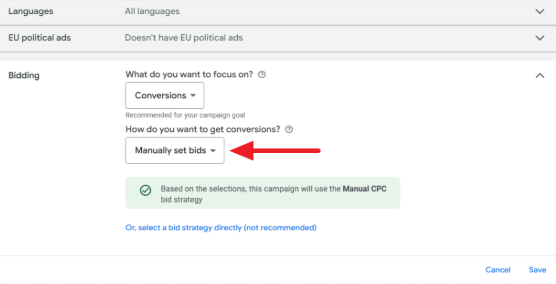
With the latest change, Manual CPC is now clearly visible within the main bidding flow. When setting up a campaign under the Conversions goal, advertisers can directly choose “Manually set bids” without bypassing Google’s recommended options. The update is reflected across campaign bidding settings throughout the Google Ads interface.
This change matters because Manual CPC remains an important strategy for many advertisers. It is often preferred for niche campaigns, low-conversion accounts, testing phases, or situations where advertisers need full control over bids. While automation works well at scale, it is not always the best fit for every campaign or business model.
From a broader perspective, Google continues to prioritize Smart Bidding and automation. However, this update signals a recognition that manual bidding still has a place particularly for experienced advertisers who understand their data and want tighter control. By reducing friction, Google is allowing advertisers to choose the strategy that best fits their needs rather than forcing a single approach.
Overall, this is a small but meaningful improvement to the Google Ads user experience, restoring balance between automation and manual control.
Summary
Google Ads has simplified access to Manual CPC by making it directly available during campaign setup. Advertisers no longer need to bypass “not recommended” options to use manual bidding. While Google continues to push automation, this update acknowledges that Manual CPC remains valuable for experienced advertisers, niche campaigns, and situations where automated bidding is not ideal.