
In the dynamic world of digital advertising, understanding Cost Per Click (CPC) is fundamental to running successful and profitable Google Ads campaigns. As we move into 2026, competition is fiercer, and algorithms are smarter. This guide will provide you with a comprehensive understanding of CPC, from the basics to advanced strategies, backed by the latest industry benchmarks and expert opinions. Whether you’re looking to lower your costs, manually control your bids, or simply understand the landscape, this professional guide has you covered .
Section 1: Understanding the Basics of CPC, PPC, and CPM
Before diving into strategies, it’s crucial to clarify the core concepts and how they relate to each other.
What is CPC in Digital Marketing?
CPC stands for Cost Per Click. It is a paid advertising metric where an advertiser pays a fee to a publisher (like Google) each time a user clicks on their ad. It’s a direct measure of the cost of acquiring a visitor to your website.
What is PPC and CPC in Digital Marketing?
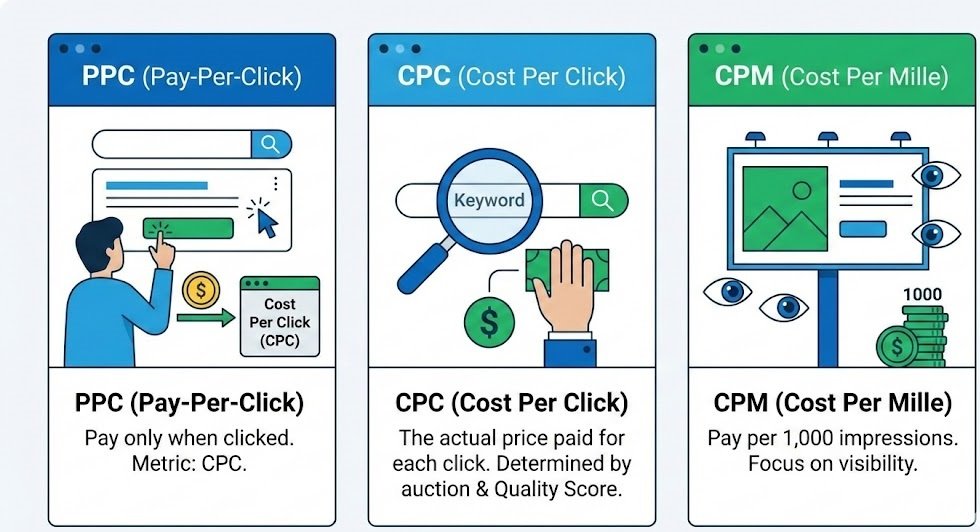
PPC (Pay-Per-Click) is the advertising model in which advertisers pay a fee each time their ad is clicked. CPC (Cost Per Click) is the metric that measures the actual cost of each of those clicks. In essence, PPC is the system, and CPC is the price you pay within that system.
What is CPC and CPM in Digital Marketing?
While CPC focuses on clicks, CPM (Cost Per Mille) stands for Cost Per Thousand Impressions. With CPM, you pay based on how many times your ad is shown (impressions), regardless of whether it’s clicked.
CPC: Best for performance-based goals like driving traffic, leads, or sales.
CPM: Best for brand awareness and visibility campaigns.
How do CPC Ads Compete with CPM Ads?
In the Google Ads auction, CPC and CPM bids are converted into a common metric to compete fairly. Google estimates how many clicks a CPM bid would generate to compare it against a CPC bid. The ad with the highest Ad Rank (a combination of your bid, Quality Score, and the expected impact of extensions) wins the auction and gets displayed.
Visual Comparison: PPC vs. CPC vs. CPM
The following image provides a clear visual breakdown of these three fundamental concepts.
Section 2: Calculating and Benchmarking CPC in 2026
Knowing how to calculate your CPC and comparing it against industry standards is vital for assessing your campaign’s health.
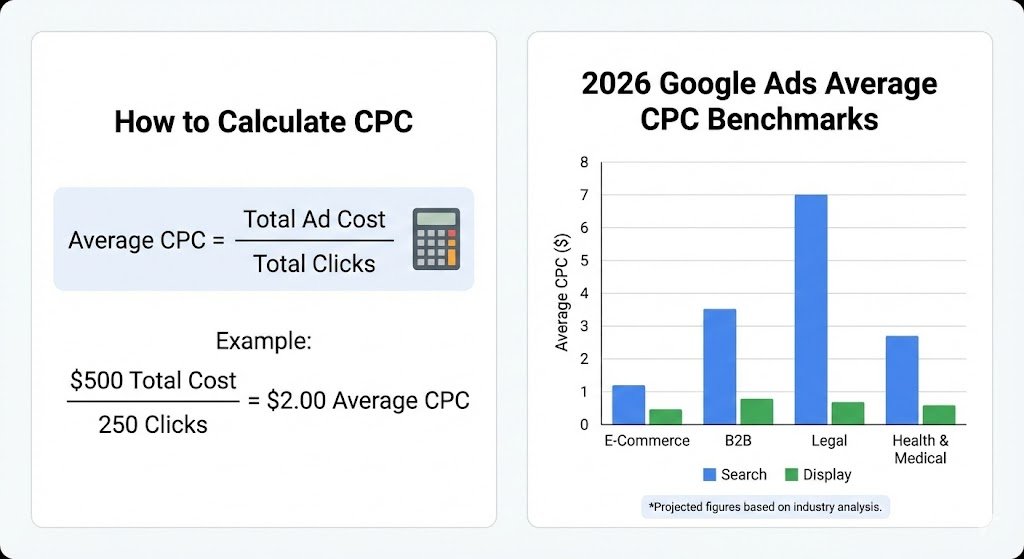
- How to Calculate CPC in Google Ads The formula for calculating your average CPC is straightforward:
Average CPC=Total Number of ClicksTotal Cost of Clicks
For example, if you spent $500 on a campaign that generated 250 clicks, your average CPC would be $2.00 ($500 / 250).
- What is a Good CPC for Google Ads in 2026? (Benchmark Data) A “good” CPC is relative and depends heavily on your industry, target audience, and campaign goals. However, knowing the averages can help you set realistic expectations. Based on 2026 projections, here are some industry benchmarks for both Google Search and Display networks.
2026 Average CPC Benchmarks (Projected)
| Industry | Search Network CPC ($) | Display Network CPC ($) |
| E-Commerce | $0.90 – $1.40 | $0.40 – $0.60 |
| B2B Services | $3.00 – $4.50 | $0.70 – $1.00 |
| Legal | $6.00 – $8.50 | $0.60 – $0.90 |
| Health & Medical | $2.50 – $3.50 | $0.50 – $0.80 |
| Finance & Insurance | $3.00 – $4.00 | $0.80 – $1.10 |
| Technology | $3.50 – $4.50 | $0.40 – $0.60 |
| Real Estate | $2.00 – $3.00 | $0.60 – $0.90 |
| Travel & Hospitality | $1.40 – $1.80 | $0.30 – $0.50 |
| All Industries Average | ~$2.69 | ~$0.63 |
Note: These are projected averages. Your actual CPC may vary based on competition, location, and ad quality.
CPC Calculation and Benchmarks Infographic
The image below illustrates the CPC calculation formula and presents a visual comparison of 2026 benchmarks across select industries.
Section 3: Managing and Optimizing Your CPC
A high CPC can drain your budget quickly. Understanding the causes and knowing how to optimize is key to a successful campaign.
- Why is My CPC So High in Google Ads? Several factors can contribute to a high CPC:
- High Competition: You’re bidding on popular, high-intent keywords.
- Low Quality Score: Google penalizes ads that are not relevant or provide a poor user experience.
- Broad Targeting: Your ads are being shown to a wide, less relevant audience.
- Poor Ad Scheduling: Your ads are running during expensive, low-converting times.
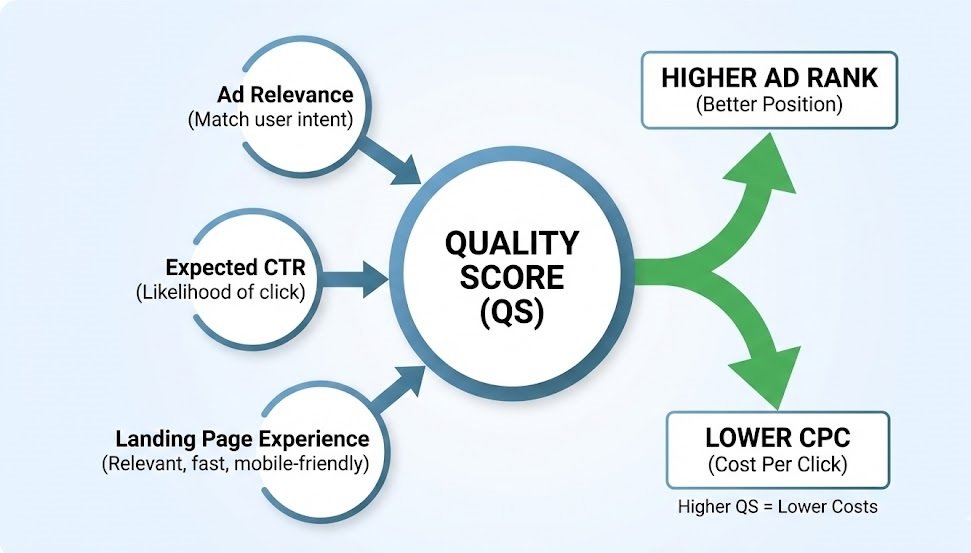
- How to Reduce Google Ads CPC The most effective way to lower your CPC is to improve your Quality Score. Quality Score is Google’s rating of the quality and relevance of both your keywords and PPC ads. It is based on three main components:
- Ad Relevance: How closely your ad matches the user’s search intent.
- Expected Click-Through Rate (CTR): The likelihood that your ad will be clicked when shown.
- Landing Page Experience: How relevant, transparent, and easy-to-navigate your landing page is for the user.
By improving these factors, you increase your Quality Score, which leads to a higher Ad Rank and, consequently, a lower CPC for the same ad position.
Expert Opinion for 2026:
Experts recommend moving beyond just chasing the lowest CPC. Instead, focus on high-intent keywords that may have a higher CPC but also a higher conversion rate, ultimately leading to a better Return on Investment (ROI). Also, avoid over-segmenting your campaigns, as this can dilute the data needed for Google’s smart bidding algorithms to work effectively.
Quality Score and CPC Relationship
The following diagram visually explains how improving the components of Quality Score directly leads to a lower CPC and a better Ad Rank.
Section 4: Advanced CPC Strategies: Manual Bidding
While automated bidding is powerful, there are times when you need granular control over your CPC, especially for your most valuable keywords.
- How to Set Manual CPC in Google Ads Manual CPC bidding lets you set a maximum amount you’re willing to pay for a click on a specific keyword.
- In your Google Ads account, go to the Campaigns or Ad groups tab.
- Select the campaign or ad group you want to edit.
- Navigate to the Keywords tab.
- In the “Max. CPC” column, click the pencil icon or the bid amount next to the keyword you want to change.
- Enter your new maximum CPC bid and click Save.
- How to Increase CPC in Google Ads (and Why You Might Want To) Increasing your CPC bid can be a strategic move. You might want to increase your bid to:
- Gain Higher Ad Position: To appear at the very top of the search results for high-value, high-converting keywords.
- Increase Impression Share: To ensure your ad is shown more often for competitive terms.
- Combat Competition: To outbid competitors for valuable traffic during peak seasons.
Visual Guide: Setting a Manual CPC Bid
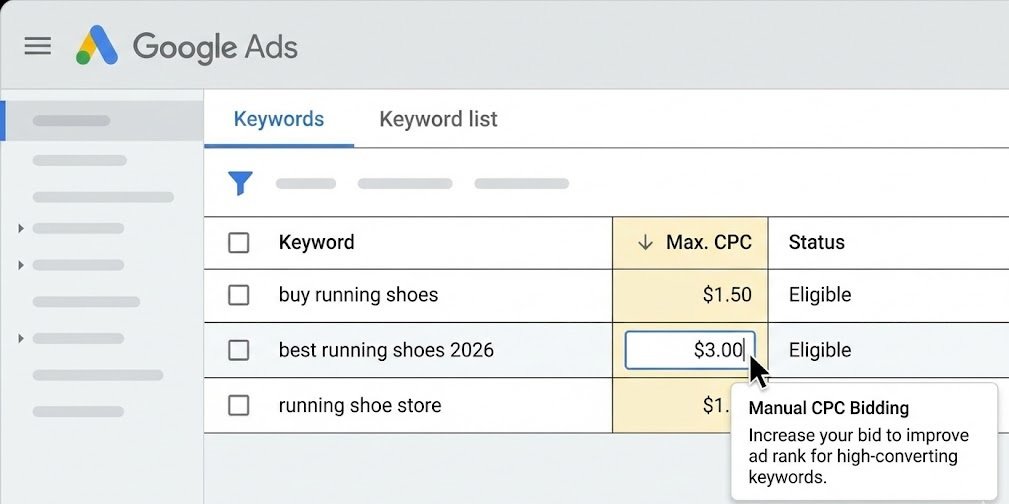
This conceptual screenshot from the Google Ads interface demonstrates how to manually adjust the Maximum CPC for a specific keyword.
Mastering CPC is an ongoing process of analysis and optimization. By understanding the fundamentals, keeping an eye on industry benchmarks, and actively managing your Quality Score, you can run efficient and profitable Google Ads campaigns in 2026 and beyond. Remember, a “good” CPC is one that helps you achieve your business goals at a sustainable cost. Continuously test, refine, and adapt your strategy to stay ahead in the competitive digital landscape.