
Introduction: The Evolution of the Auction
The days of manually adjusting keyword bids by a few cents every morning are long gone relegated to the history books of digital marketing alongside keyword stuffing and flash intros.
Today, PPC bidding is a high-speed, automated financial market. It is driven by machine learning algorithms that digest thousands of data signals in milliseconds to determine the optimal price for an impression.
However, automation does not mean “set it and forget it.” As an industry expert, I can tell you that the role of the human strategist has never been more critical. Your job is no longer to pull the levers; it is to program the machine that pulls them.
This guide will walk you through the realities of placing bids for keywords in 2026, covering the essential vocabulary, the strategic shifts, and the step-by-step execution required to dominate your market.
Table of Contents
- Defining the Core mechanics: Cost and Clicks
- Categorizing Intent: Branded vs. High-Value Keywords
- The 2026 Strategic Playbook: Automated Bid Strategies
- Competitive Warfare: Brand Defense and Conquesting
- Step-by-Step: Executing Your 2026 Bidding Framework
- Conclusion
1. Defining the Core Mechanics: Cost and Clicks
Before diving into complex AI strategies, we must ground ourselves in the fundamental economics of the platform.
What is PPC Bidding?
At its core, what is PPC bidding? It is an auction where advertisers compete for ad placement on search engine results pages (SERPs) or display networks. Unlike a traditional auction where the highest bidder always wins, platforms like Google Ads use a combination of your bid and your “Quality Score” (relevance of your ad and landing page) to determine who wins and how much they pay.
In 2026, this definition has expanded. You aren’t just bidding for a keyword click; you are bidding for a probability of conversion based on the user’s historical behavior, device, location, and intent signals.
What is Bid Amount Per Click vs. Keyword Cost?
The bid amount per click (Max CPC) is the maximum you tell the platform you are willing to pay.
The actual keyword cost (Actual CPC) is what you end up paying. In a second-price auction model (which still influences modern systems), you typically pay just enough to beat the next highest competitor’s ad rank, plus a cent. Crucial 2026 Insight: In automated strategies, you rarely set a manual Max CPC anymore. Instead, you give the AI a target (like “spend $50 to get one sale”), and the AI calculates the necessary bid amount per click in real-time to achieve that goal
2. Categorizing Intent: Branded vs. High-Value Keywords
Not all keywords deserve the same bidding strategy. Success in 2026 requires rigorous segmentation based on intent and value.
What Are Branded Keywords?
Branded keywords are search terms that include your company name or unique product names (e.g., “Nike shoes,” “Salesforce CRM”).
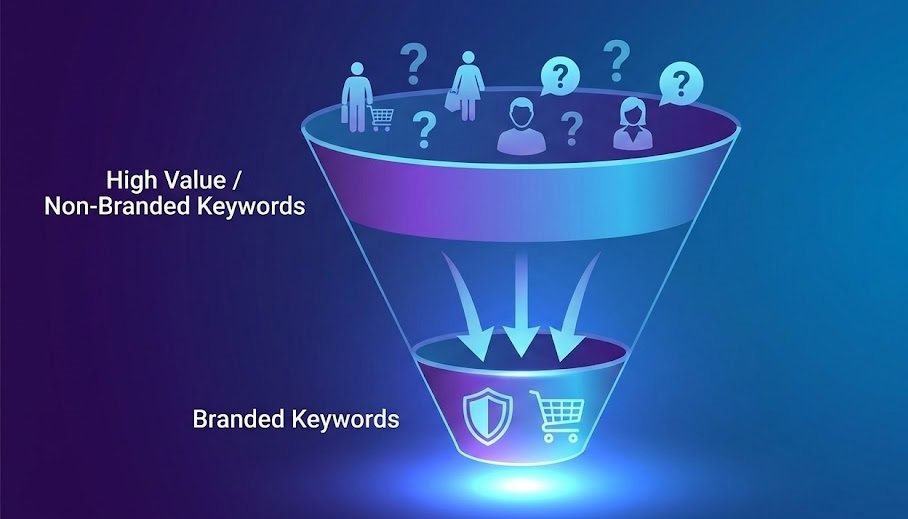
- The 2026 Perspective: These are your lowest funnel, highest converting assets. They should have their own dedicated campaigns. The strategy here is defense and maximizing impression share. You want to ensure that when someone specifically seeks you out, you control the message, not a competitor.
Identifying High Value Keywords
High value keywords are non-branded terms displaying strong commercial intent. These are expensive but necessary for growth (e.g., “best enterprise accounting software 2026,” “emergency plumber near me”).
- The 2026 Perspective: You cannot afford to bid on these broadly. In 2026, we use “broad match combined with Smart Bidding.” We rely on the AI to look past the literal keyword string and identify if the user behind the search is actually ready to buy, only bidding aggressively when intent signals are high.
3. The 2026 Strategic Playbook: Automated Bid Strategies
If you are asking “how to bid on Google keywords” in 2026, the answer is almost universally: Smart Bidding.
Manual CPC is largely obsolete for growth campaigns. It cannot compete with the speed at which Google’s AI adjusts to real-time signals. Here are the dominant keyword bid strategies of 2026:
A. Target ROAS (Return On Ad Spend) – The eCommerce Standard
This is the gold standard for any business with trackable revenue. You tell the AI: “For every $1 I spend, I want $4 back in revenue (400% ROAS).” The AI then predicts the conversion value of every potential click and bids accordingly. If a user seems unlikely to spend much, the bid is lowered automatically.
B. Target CPA (Cost Per Acquisition) – The Lead Gen Standard
Used when you need a specific action (a form fill, a download) rather than a direct sale. You set a target cost (e.g., “$30 per lead”), and the AI maneuvers bids to attain as many conversions as possible at that average cost.
C. Maximize Conversion Value (with Guardrails)
This strategy tells the AI to spend your entire daily budget to get the highest possible revenue, regardless of efficiency. In 2026, savvy experts always apply a “target ROAS floor” to this strategy to prevent the system from spending wildly on low-margin sales.
4. Competitive Warfare: Brand Defense and Conquesting
The most contentious aspect of PPC is competitive bidding. Understanding who is playing in your sandbox is vital.
Who Is Bidding On My Keywords?
You must regularly check your “Auction Insights” reports in Google Ads or use third-party tools like Semrush. These tools reveal who is bidding on my keywords, how often their ads appear above yours, and their impression share.
Crucial 2026 Insight: If a competitor suddenly appears with a high impression share on your core terms, they are likely using an aggressive Target Impression Share strategy against you.
PPC Bidding On Your Competitors’ Brand (Conquesting)
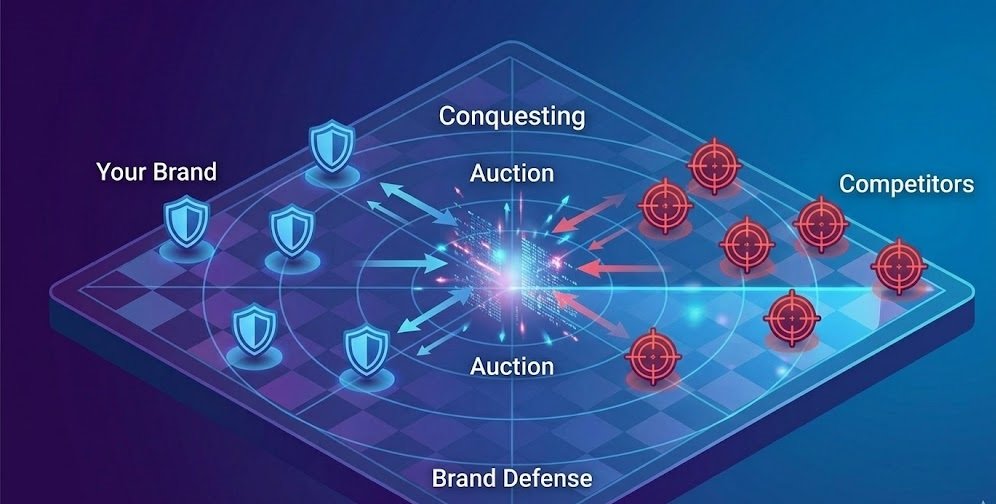
This is the practice of deliberately bidding on keywords containing your competitor’s brand names.
- Pros: It captures high-intent traffic right at the moment they are considering a rival. It’s aggressive growth.
- Cons/Risks: It often leads to a bidding war that drives up keyword costs for everyone. Your Quality Score will be low for their brand names, making clicks expensive.
- The Expert Verdict: Use carefully. In 2026, we only use conquesting strategies against specific, vulnerable competitors where we have a clear, demonstrable product advantage we can highlight in the ad copy.
5. Step-by-Step: Executing Your 2026 Bidding Framework
Knowing the strategies is one thing; implementing them is another. Here is the workflow for setting up bids in 2026.
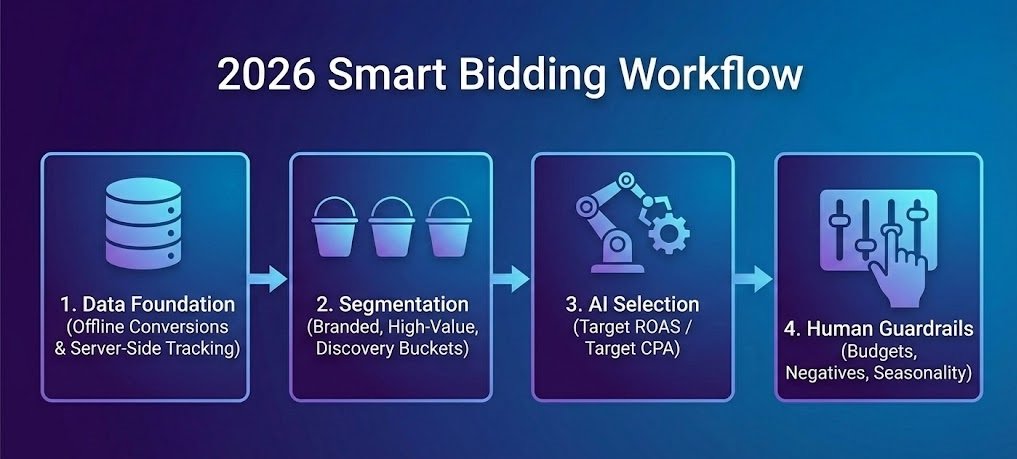
Step 1: The Data Foundation (Crucial Pre-Requisite)
You cannot use modern bidding without flawless data. The AI needs to know what success looks like. You must have robust conversion tracking set up, ideally feeding first-party data back into the ad platform (e.g., offline conversions, CRM data) to navigate privacy regulations.
Step 2: Segmentation by Value
Don’t dump all keywords into one campaign.
- Campaign A (Defense): Branded Keywords only.
- Campaign B (Offense): High-Value, Non-Branded terms.
- Campaign C (Discovery): Broader research terms.
Step 3: Selecting the AI Strategy
Apply the appropriate Smart Bidding strategy to the campaign based on its goal.
- Example: Set Campaign B to Target ROAS of 350%.
Step 4: The Human “Guardrails”
This is where you earn your money. AI will chase whatever goal you set, sometimes off a cliff. You must set constraints:
- Budget Caps: Ensure the AI doesn’t spend your monthly budget in two days.
- Negative Keywords: Continuously add irrelevant terms so the AI doesn’t waste money learning they are bad.
- Seasonality Adjustments: Manually inform the AI if you expect a sudden spike in conversion rates due to a sale (e.g., Black Friday) so it bids aggressively enough.
6. 2026 Industry Benchmarks (Illustrative)
Understanding where you stand against the market is crucial. Below are illustrative benchmarks for 2026 across key industries. Note: These are for reference and can vary significantly based on competition, geography, and ad quality.
7. Conclusion:
In 2026, the question isn’t “how much should I bid for this keyword?” The question is “how much is this specific user’s intent worth to my business right now?”
The machines are infinitely better at answering that second question in real-time than any human.
Your role as a marketer has shifted from being a day-trader making small transactions to a portfolio manager setting the strategy. Success in bids for keywords today requires trusting the automation to handle the heavy lifting, while you focus on feeding it better data, creating compelling creatives, and ensuring the strategy aligns with business goals. Embrace the AI, set strong guardrails, and dominate the auction.